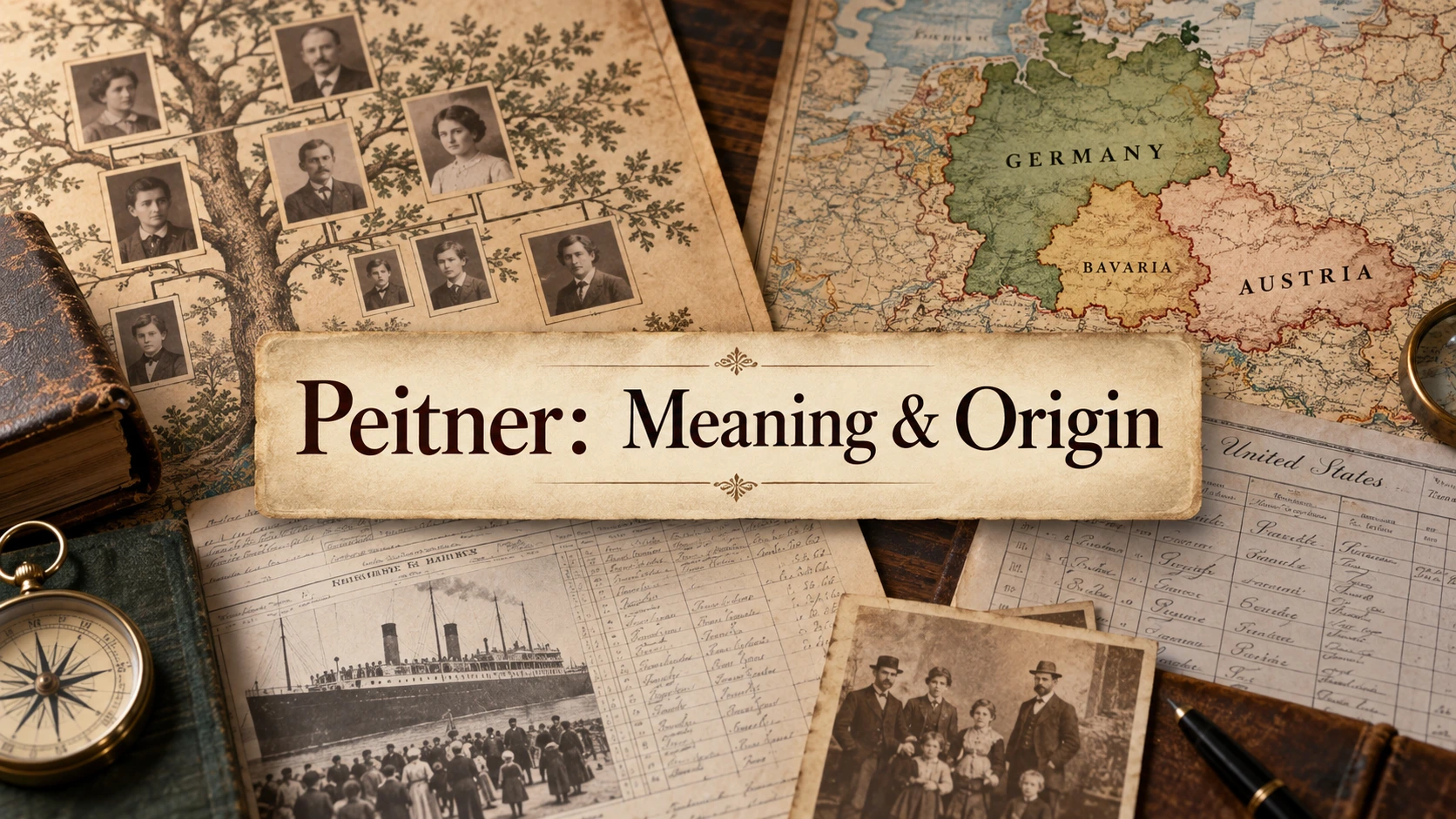
If you found Peitner in a family tree, old census record, immigration document, or genealogy website, you may be wondering where the name came from. Is Peitner German, Austrian, or connected to Jewish ancestry? Peitner is an uncommon surname associated with German-speaking Central Europe, but historical sources point to more than one possible meaning and origin. One interpretation links the name to a geographic feature, while another is associated with an Ashkenazic Jewish occupational tradition. A surname by itself cannot prove an exact family origin or ancestry. The sections ahead look at the Peitner meaning, German and Austrian connections, the Ashkenazic Jewish interpretation, spelling variants such as Peintner and Peithner, U.S. historical records, and practical ways to trace a Peitner ancestor.

TL;DR: Peitner at a Glance
- It is an uncommon surname associated with German-speaking Central Europe.
- One documented interpretation connects the name with a mountain slope or spur.
- A separate interpretation connects Peitner with an Ashkenazic Jewish occupational tradition.
- For a Peitner ancestor in the U.S., rely on names, dates, locations, census records, immigration records, and other historical documents rather than the surname alone.
What Does the Peitner Last Name Mean?
The Peitner last name has more than one documented interpretation. One German/Austrian explanation connects it with a mountain slope or mountain spur, while another links the family name to an Ashkenazic Jewish occupational tradition.
Under the German-speaking interpretation, Peitner can be viewed as a topographic surname—a family name associated with a geographic feature near where an ancestor lived. Its etymology is connected with older German linguistic usage, including the Middle High German period.
That makes “Peitner meaning” less straightforward than a single dictionary definition. Historical sources provide different explanations, so the name should not be assigned one universal meaning.
For genealogy, the surname is best treated as a clue rather than proof of ancestry. The name alone cannot establish whether a particular family branch came from Germany, Austria, or another German-speaking region. Records showing names, places, dates, and family relationships offer stronger evidence.
Where Does the Peitner Surname Come From?
The Peitner surname origin is associated with German-speaking Central Europe, with Germany, Austria, and Bavaria providing useful historical context. The name may reflect regional German naming traditions, but its exact starting point cannot be assigned to one modern country with certainty.
Historical borders changed repeatedly across Central Europe. A place that was considered part of one state or kingdom generations ago may now fall within another country. Migration also carried family names across nearby regions, while spelling could change as families moved or records were written by different officials.
For genealogy, this is why a modern map should not be treated as proof of the surname’s original location. A family record showing an ancestor in Austria, for example, does not automatically mean the surname began there. Earlier parish, civil, immigration, and family records can provide a clearer trail.
Geographic Context
| Region | Relevance to Peitner Research |
| Germany | German surname and linguistic context |
| Austria | Austrian and German-speaking naming traditions |
| Bavaria | Important historical regional context |
| Central Europe | Broader geographic setting |
| United States | Immigration and later family records |
Two Historical Explanations
Historical surname sources give two different explanations, so the name should not be treated as having one fixed origin. The distinction matters when researching German, Austrian, or Jewish family history.
German/Austrian Topographic Interpretation
One interpretation describes as a topographic surname connected with a mountain slope or mountain spur. This fits a German-speaking naming tradition in which geographic features could become family names. It provides a possible German or Austrian context, but it does not prove that every family came from the same place.
Ashkenazic Jewish Occupational Interpretation
A separate explanation connects with an Ashkenazic Jewish surname and a Yiddish occupational tradition associated with soldering. This interpretation is distinct from the geographic explanation and should be considered separately when researching Jewish ancestry.

Why These Interpretations Should Be Kept Separate
So, a Jewish surname or a German surname? Historical sources support both interpretations, depending on the family line. Different families can potentially share the same surname without having a common recent ancestor. Similar meanings also do not establish a shared family line. Documentary evidence—such as birth, marriage, immigration, census, and parish records—is needed to connect a branch to a specific ancestry. Surname etymology is a useful starting point, not proof.
Is Peitner a German or Austrian Surname?
Peitner can be associated with both German and Austrian surname traditions, particularly within German-speaking Central Europe. Bavaria provides useful historical context for German surname research, while Austria is also relevant to the name’s linguistic and geographic background.
Migration makes the question less straightforward. Families moved across regions long before modern borders were fixed, and an ancestor recorded in Austria may have earlier family connections elsewhere in Central Europe. Spelling could also change as families moved and entered new records.
For U.S. readers researching an American ancestor, the last name alone cannot establish nationality. A census record, passenger list, naturalization document, church record, or other family-history source may reveal where an ancestor was actually born. Those details provide a stronger path toward identifying a family’s European background.
Peitner, Peintner, and Peithner: Are They the Same?
Peitner spelling variations can appear in genealogy records, especially when documents were created in different regions or periods. Peintner and Peithner are alternate forms worth checking when researching the family name.
Regional spelling differences were common, and clerks may have recorded a surname according to local pronunciation, spelling habits, or the information given to them. Immigration and other historical records can also contain variations from one document to another.
For someone researching Peitner vs Peintner, searching multiple forms can uncover records that a single spelling might miss. Still, a similar spelling does not automatically mean two families are related. Each possible connection should be checked against names, dates, locations, relatives, and original records.
Spelling Variations
| Surname Form | How to Use It in Genealogy |
| Peitner | Primary spelling to search |
| Peintner | Possible historical or alternate spelling |
| Peithner | Another spelling worth checking |
| Other variants | Verify each one against records |
How to Research a Peitner Ancestor in the United States
If you found an American family tree or historical document, start with the most recent confirmed relative and work backward through records. This approach can help connect Peitner ancestors in America to earlier generations and, eventually, a European birthplace.
Start With Known Family Information
Begin with full names, birth dates, marriage dates, death dates, parents, spouses, and known towns or states. Even a middle name or county can help separate one family from another.
Search U.S. Historical Records
For Peitner genealogy USA research, check U.S. Census records, immigration records, passenger lists, naturalization records, birth, marriage and death records, military records, and church or parish records. Compare details across documents rather than relying on one entry.
Work Back Toward Europe
A practical research path is:
U.S. ancestor → state/county → immigration or naturalization record → European birthplace → earlier family records
This can strengthen a family history USA search and may reveal connections to Germany, Austria, Bavaria, or another Central European location. Peitner census records and immigration records can be especially useful starting points.
What Can the Peitner Surname Tell You About Your Ancestry?
Researching the surname can provide useful clues about a family’s past. Its possible geographic associations may point toward German-speaking Central Europe, while its linguistic history can offer clues about naming traditions. Spelling variations such as Peintner or Peithner can also give genealogy researchers additional records to investigate.
But a surname is only a starting point. Peitner alone cannot prove an exact nationality, birthplace, ethnicity, or religion. It also cannot establish that two people with the same surname belong to the same family. For a reliable family history, researchers should compare the surname with documented names, dates, locations, relationships, immigration records, and other original historical sources.
How Common Is the Peitner Surname?
Peitner is a relatively uncommon surname, but historical genealogy databases contain records showing the name in different locations, including the United States. Its geographic distribution is better understood through historical records than through unsupported estimates of how many people currently use the name.
Record totals also don’t represent the number of living individuals. A database may contain multiple records for the same person or family across different years. For family research, the most useful approach is to trace individual records and confirm names, dates, places, and relationships.
| Question | Short Answer |
| Is Peitner a common surname? | No, it is relatively uncommon |
| Are Peitner records found in the U.S.? | Yes |
| Do record counts equal living people? | No |
| Best way to research a family branch? | Use genealogical records |

Frequently Asked Questions
What does Peitner mean?
Peitner has more than one documented interpretation. One connects the name with a mountain slope or spur in a German-speaking context, while another links it to an Ashkenazic Jewish occupational tradition involving soldering.
Where does the surname come from?
The Peitner surname is associated with German-speaking Central Europe, including Germany, Austria, and Bavaria. Historical migration and changing borders make it difficult to assign one modern location as the family’s original home.
Is Peitner a German surname?
It can be considered a German surname based on its documented German-speaking linguistic and geographic context. However, the surname alone cannot establish that every Peitner family originated in Germany or shares the same ancestry.
Is Peitner an Austrian surname?
Peitner can also appear in an Austrian context, particularly within German-speaking naming traditions. A family’s presence in Austria does not by itself prove that the surname originated there, so historical records are needed.
Is Peitner a Jewish surname?
One documented interpretation connects Peitner with an Ashkenazic Jewish occupational tradition and Yiddish. That does not mean every person named has Jewish ancestry; individual family records are needed to establish a specific connection.
Are Peitner and Peintner related?
Peintner is a spelling variation worth checking when researching ancestors. Similar spellings can appear in historical records, but the names should not automatically be treated as belonging to the same family.
How can I find Peitner ancestors in the U.S.?
Start with the most recent confirmed relative, then search census, immigration, passenger, naturalization, vital, military, and church records. Compare names, dates, locations, and family relationships as you work backward.
Final Takeaway
Peitner is an uncommon surname with more than one documented historical interpretation. The German/Austrian topographic explanation and Ashkenazic Jewish occupational explanation should not automatically be treated as one family origin. Peintner and Peithner can also be useful spelling variants during genealogy research. For U.S. families, census, immigration, naturalization, vital, and other historical records can help establish ancestry. The surname is the clue; the records establish the family connection.
Leave a Reply