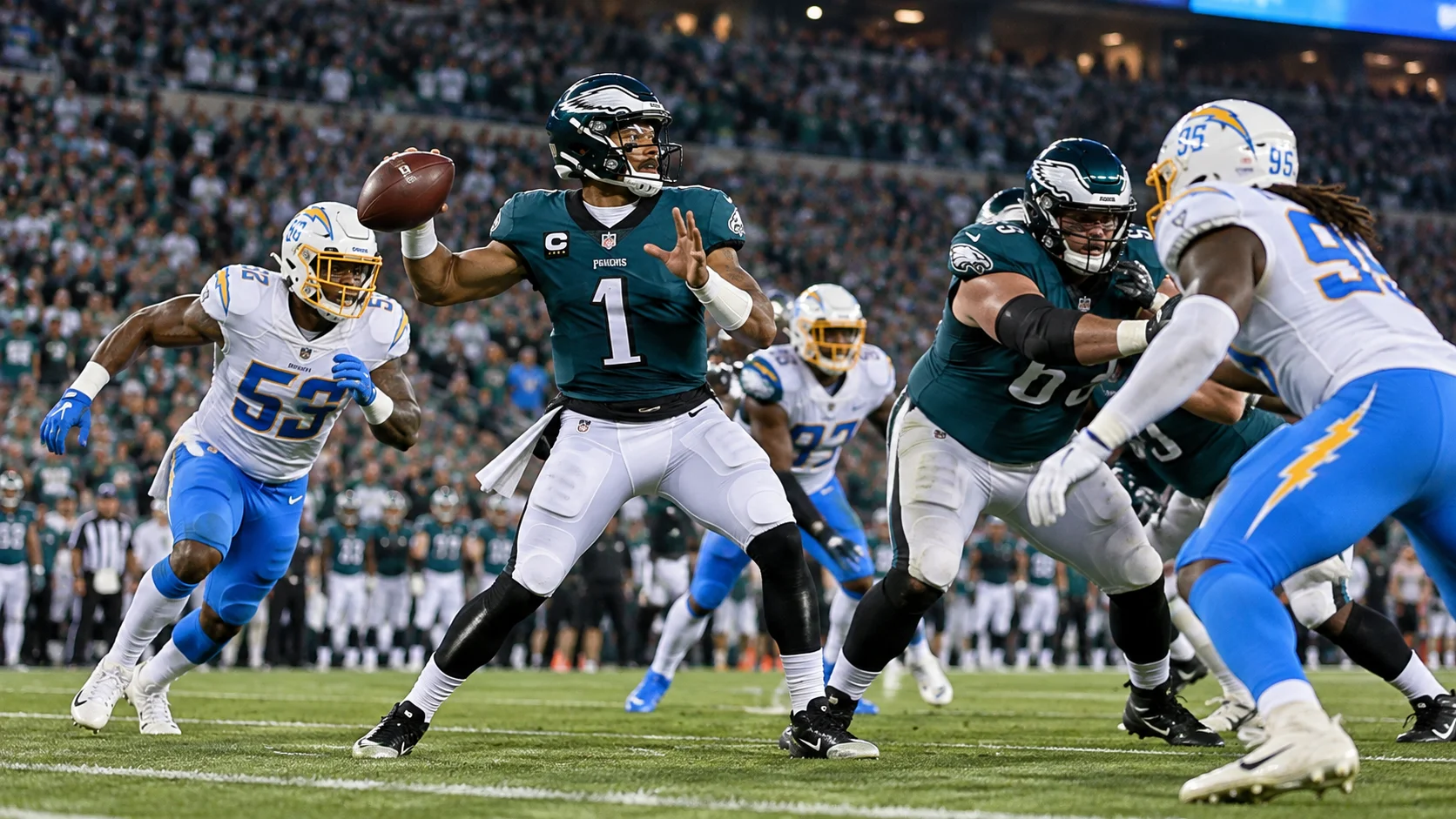
The Eagles vs Chargers matchup brings together two competitive NFL franchises with different playing styles, talented quarterbacks and a history of close games. Philadelphia is known for its physical approach and strong running game, while Los Angeles relies on quarterback play, defensive pressure and timely scoring.
Their most recent meeting took place on December 8, 2025, when the Los Angeles Chargers defeated the Philadelphia Eagles 22-19 in overtime at SoFi Stadium in Inglewood, California.
The game featured dramatic momentum changes, costly turnovers, an impressive rushing touchdown and a decisive overtime field goal. Philadelphia gained more total yards, but Los Angeles made better use of its opportunities when the result was on the line.
Eagles vs Chargers: Latest Game Overview
The December 2025 contest was played during Week 14 of the NFL regular season. Both teams entered the matchup looking to strengthen their playoff positions.
The Chargers established an early advantage, but the Eagles remained within striking distance throughout the first three quarters. Philadelphia eventually moved ahead in the fourth quarter before Los Angeles forced overtime with a late field goal.
The extra period delivered another tense finish. Cameron Dicker converted a 54-yard field goal to give the Chargers a three-point advantage, and the Los Angeles defense prevented Philadelphia from responding.
Eagles vs Chargers Match Summary
| Game Detail | Information |
|---|---|
| Match | Philadelphia Eagles vs Los Angeles Chargers |
| Date | December 8, 2025 |
| Competition | NFL Regular Season, Week 14 |
| Venue | SoFi Stadium, Inglewood, California |
| Final Score | Chargers 22, Eagles 19 |
| Winning Team | Los Angeles Chargers |
| Result | Overtime victory |
| Eagles Head Coach | Nick Sirianni |
| Chargers Head Coach | Jim Harbaugh |
| Decisive Play | Cameron Dicker’s 54-yard overtime field goal |
Eagles vs Chargers: How the Game Unfolded
First Quarter: Chargers Make the Early Statement
Los Angeles started strongly by moving the football efficiently and creating an early scoring opportunity.
Justin Herbert connected with rookie running back Omarion Hampton for a four-yard touchdown pass. The play gave the Chargers a 7-0 lead and immediately put pressure on Philadelphia.
The Eagles answered with a 41-yard field goal from Jake Elliott, reducing the deficit to four points.
At the end of the first quarter, the Chargers led 7-3.
Second Quarter: Both Defenses Hold Firm
The second quarter became a battle for field position.
Neither offense managed to produce a touchdown. The Chargers extended their advantage through a 45-yard Cameron Dicker field goal, while Philadelphia answered with a 30-yard kick from Elliott.
Los Angeles entered halftime ahead 10-6.
The low-scoring first half demonstrated how difficult both defenses made it for their opponents to finish drives.
Third Quarter: Philadelphia Stays Within Reach
The Chargers added another field goal in the third quarter, extending their lead to 13-6.
Philadelphia continued moving the ball but struggled to turn possessions into touchdowns. Elliott connected from 54 yards to keep the Eagles close.
The third quarter ended with Los Angeles holding a 13-9 advantage.
With only four points separating the teams, the contest remained open heading into the final period.
Fourth Quarter: A Dramatic Change in Momentum
The fourth quarter produced the game’s biggest offensive highlight.
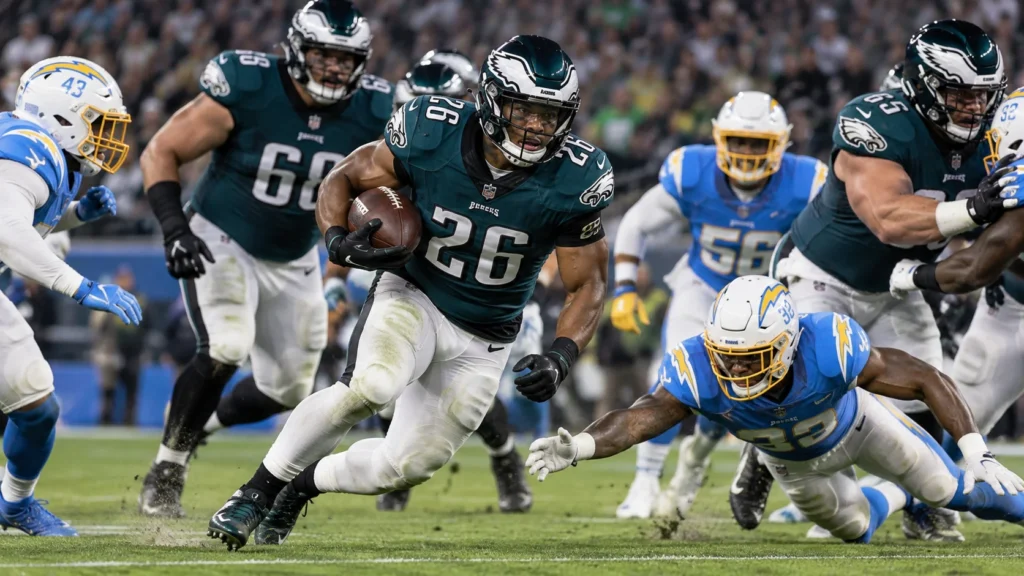
Saquon Barkley broke free for a 52-yard rushing touchdown, giving Philadelphia its first lead at 16-13.
Los Angeles responded with a Cameron Dicker field goal to tie the game at 16-16.
Elliott then converted another field goal, putting Philadelphia ahead 19-16 with just over two minutes remaining.
However, the Chargers refused to surrender. Herbert helped move the offense into field-goal range, and Dicker made a 46-yard attempt with eight seconds remaining.
The score was tied 19-19 at the end of regulation.
Overtime: Chargers Secure the Victory
Both teams entered overtime knowing a single mistake could decide the result.
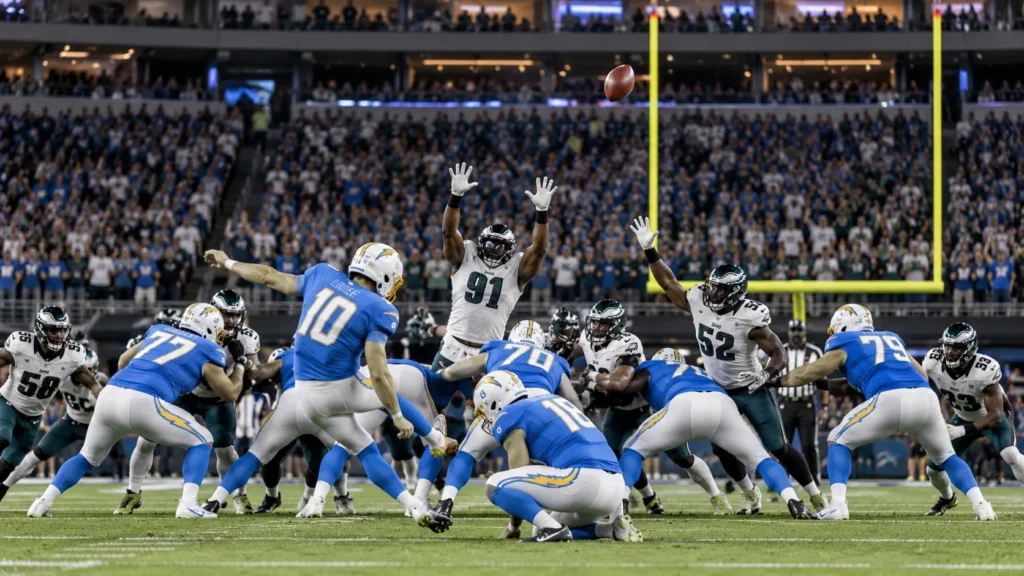
Dicker delivered again, making a 54-yard field goal to put Los Angeles ahead 22-19.
Philadelphia still had an opportunity to respond, but Jalen Hurts threw an interception near the goal line. Tony Jefferson secured the ball after a deflection by Cam Hart.
That defensive play ended the contest and confirmed a dramatic Chargers victory.
Eagles vs Chargers Player Stats and Performances
The final score tells only part of the story. Several players had a significant influence on the result, particularly the quarterbacks, running backs and kickers.
Jalen Hurts: Passing Production Undermined by Turnovers
Philadelphia quarterback Jalen Hurts completed 21 of 40 passes for 240 yards.
Although he moved the offense through the air, he also threw four interceptions and finished without a passing touchdown.
Those turnovers were especially damaging because Philadelphia generated enough yardage to compete for the victory.
Hurts’ performance demonstrated the importance of protecting possession in closely contested NFL games.
Justin Herbert: Leadership Under Pressure
Justin Herbert guided the Chargers through a difficult defensive matchup.
Philadelphia’s pass rush regularly pressured him, recording seven sacks during the contest.
Despite those challenges, Herbert continued creating opportunities and helped Los Angeles remain competitive.
His ability to extend plays and keep drives alive was particularly valuable during the closing stages.
Saquon Barkley: Philadelphia’s Biggest Offensive Threat
Saquon Barkley delivered one of Philadelphia’s strongest individual performances.
He rushed for 122 yards on 20 carries and scored the Eagles’ only touchdown.
His 52-yard scoring run completely changed the momentum early in the fourth quarter.
Barkley’s performance showed how a productive running game can keep an offense competitive even when its passing attack struggles.
Cameron Dicker: The Decisive Performer
Cameron Dicker was central to the Chargers’ victory.
He made five field goals, including the kick that forced overtime and the 54-yard attempt that ultimately decided the game.
His accuracy under pressure allowed Los Angeles to convert scoring opportunities without needing multiple touchdowns.
Eagles vs Chargers: Important Game Statistics
| Statistical Category | Philadelphia Eagles | Los Angeles Chargers |
|---|---|---|
| Final Points | 19 | 22 |
| First Quarter | 3 | 7 |
| Second Quarter | 3 | 3 |
| Third Quarter | 3 | 3 |
| Fourth Quarter | 10 | 6 |
| Overtime | 0 | 3 |
| Total Net Yards | 365 | 275 |
| Penalties | 6 | 7 |
| Penalty Yards | 53 | 55 |
| Time of Possession | 29:26 | 38:05 |
Philadelphia gained 90 more total net yards than Los Angeles but still lost the game. The Chargers also controlled possession for a significantly longer period.
This difference highlights the impact of turnovers, clock management and execution in high-pressure situations.
Eagles vs Chargers: What Decided the Game?
Turnovers Made the Biggest Difference
The Eagles produced more offensive yards but failed to protect the football consistently.
Hurts’ four interceptions repeatedly disrupted Philadelphia’s offensive rhythm.
The final interception was particularly costly because it ended the Eagles’ chance to answer the Chargers’ overtime field goal.
Los Angeles demonstrated that defensive takeaways can outweigh an opponent’s statistical advantage.
The Chargers Controlled Important Possessions
Los Angeles held the football for more than 38 minutes, compared with Philadelphia’s approximately 29 minutes.
Longer possessions helped the Chargers manage the pace of the contest.
Although possession time alone does not determine the winner, controlling the clock can reduce an opponent’s scoring opportunities.
Special Teams Played a Major Role
Both teams depended heavily on their kickers.
Philadelphia’s Jake Elliott converted four field goals, keeping the Eagles competitive when offensive drives stalled.
Cameron Dicker was even more influential for Los Angeles, delivering five successful field goals.
His late fourth-quarter kick and overtime winner were among the game’s defining moments.
Philadelphia Eagles: Strengths and Areas for Improvement
The Eagles have built their identity around physical football, a mobile quarterback and a running game capable of producing explosive plays.
Their offense becomes especially difficult to defend when Jalen Hurts and Saquon Barkley are both effective.
Strong Running Game
Barkley’s performance against Los Angeles demonstrated Philadelphia’s ability to create scoring opportunities through rushing plays.
A productive ground attack also helps establish manageable passing situations.
However, Philadelphia must balance its rushing success with efficient passing to avoid becoming predictable.
Offensive Ball Security
Turnovers remain an important concern whenever an offense gives the ball away repeatedly.
Against the Chargers, Philadelphia’s passing mistakes prevented the team from fully benefiting from its yardage advantage.
Improving decision-making under pressure and protecting the football are essential for success against strong defenses.
Defensive Resilience
Philadelphia’s defense created considerable pressure on Herbert and registered seven sacks.
That performance showed the effectiveness of its pass rush.
However, the Chargers still managed to produce enough points to win, particularly through field goals.
The challenge for Philadelphia is turning defensive pressure into more drive-ending stops and favorable field position.
Los Angeles Chargers: Why Their Approach Worked
The Chargers demonstrated patience and resilience throughout the matchup.
Rather than relying on constant explosive offensive plays, Los Angeles took advantage of scoring opportunities and maintained defensive discipline.
Herbert’s Ability to Extend Plays
Justin Herbert remains an important part of the Chargers’ offensive identity.
His combination of arm strength, mobility and decision-making gives Los Angeles several ways to attack opposing defenses.
Against Philadelphia, he faced significant pressure but continued competing through the closing stages.
Defensive Playmaking
The Chargers’ secondary delivered several important plays against Hurts.
Four interceptions limited Philadelphia’s scoring opportunities and helped compensate for the Eagles’ advantage in total yards.
Tony Jefferson’s overtime interception provided the final defensive statement.
Reliable Kicking
Dicker’s performance demonstrated the value of dependable special teams.
When touchdown opportunities were limited, the Chargers still found ways to score.
His long-distance accuracy gave Los Angeles an important advantage in a game decided by only three points.
Eagles vs Chargers Head-to-Head History
The Eagles and Chargers have faced each other periodically since 1974.
Because they compete in different conferences, their regular-season meetings are less frequent than divisional rivalries.
Through their December 2025 matchup, the Chargers led the all-time regular-season series 9-5.
Several encounters have been decided by narrow margins, including the Chargers’ 27-24 victory in 2021 and Philadelphia’s 26-24 win in 2017.
These results demonstrate how competitive the matchup has been across different generations of players and coaches.
The rivalry may not attract the same annual attention as traditional divisional contests, but its history includes several closely contested games.
What the Latest Eagles vs Chargers Game Revealed
The December 2025 meeting provided several lessons about winning close NFL contests.
First, offensive yardage does not always translate into points. Philadelphia moved the ball effectively at times but struggled to finish enough drives.
Second, defensive takeaways can change the outcome of a game even when the opposing offense appears productive.
Third, reliable special teams can become decisive when two defenses prevent consistent touchdown scoring.
Finally, the Chargers showed the importance of remaining composed during difficult moments.
Los Angeles surrendered a fourth-quarter lead but recovered quickly enough to force overtime and eventually secure the victory.
Eagles vs Chargers in the 2026 NFL Season
As of October 9, 2026, the December 2025 overtime contest remains the teams’ most recent regular-season head-to-head meeting.
The Philadelphia Eagles and Los Angeles Chargers are not scheduled to face each other during the 2026 regular season.
Both franchises are instead competing through their respective schedules, with Philadelphia representing the NFC East and Los Angeles competing in the AFC West.
A future matchup would offer another opportunity to compare their offensive approaches, defensive adjustments and quarterback performances.
For now, their latest meeting remains a reminder of how small details can determine the result between competitive NFL teams.
Frequently Asked Questions About Eagles vs Chargers
1. Who won the latest Eagles vs Chargers game?
The Los Angeles Chargers defeated the Philadelphia Eagles 22-19 in overtime on December 8, 2025.
2. Where was the Eagles vs Chargers game played?
The latest matchup took place at SoFi Stadium in Inglewood, California, during Week 14 of the 2025 NFL season.
3. Who scored the winning points for the Chargers?
Cameron Dicker kicked a 54-yard field goal in overtime to give Los Angeles the winning advantage.
4. How many passing yards did Jalen Hurts record?
Jalen Hurts completed 21 of 40 passes for 240 yards and threw four interceptions.
5. How did Saquon Barkley perform against the Chargers?
Barkley rushed for 122 yards on 20 carries, including a 52-yard touchdown run.
6. Which team leads the Eagles vs Chargers head-to-head record?
The Chargers lead the all-time regular-season series 9-5 through December 2025.
7. Will the Eagles play the Chargers in 2026?
The two teams are not scheduled to meet during the 2026 NFL regular season, although a postseason meeting remains possible.
Final Thoughts
The latest Eagles vs Chargers game delivered a dramatic example of how unpredictable professional football can be.
Philadelphia produced more offensive yards and received a strong rushing performance from Saquon Barkley, but costly turnovers prevented the Eagles from securing the victory.
Los Angeles relied on defensive takeaways, Justin Herbert’s determination and Cameron Dicker’s outstanding kicking to complete a 22-19 overtime win.
The matchup demonstrated that winning in the NFL requires more than offensive production. Protecting possession, responding to pressure and executing during decisive moments can make the difference between victory and defeat.
Leave a Reply